

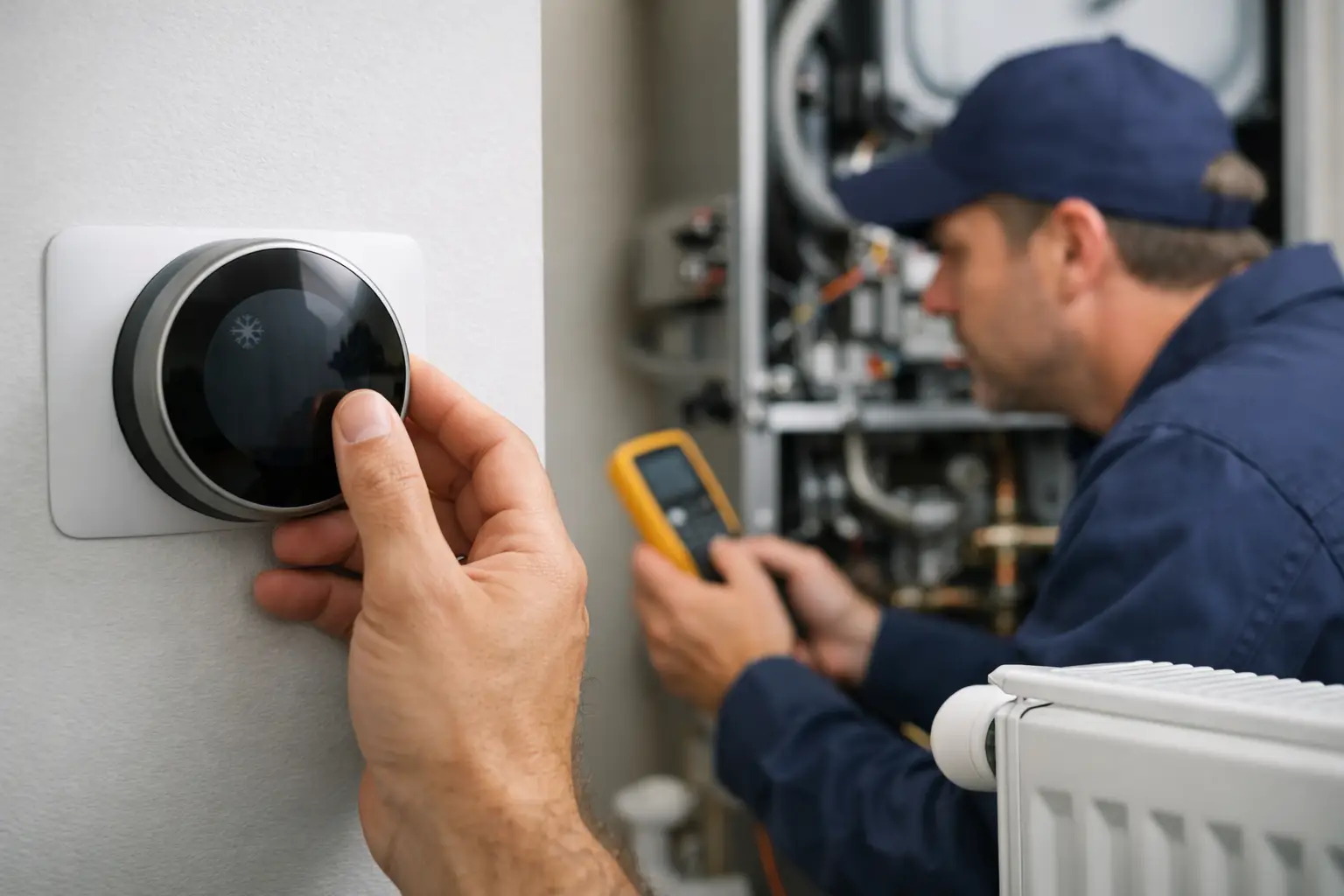
A thermostat that shows the right temperature but does not bring the heating on can make a home feel uncomfortable very quickly. If your thermostat not controlling heating problem has appeared suddenly, the cause may be as simple as flat batteries or an incorrect programme. In other cases, it can point to a communication fault, a boiler issue or a problem with the heating controls that needs professional attention.
Before assuming the boiler has failed, it is worth making a few safe checks. They can help you understand what is happening and give an engineer a clearer picture if a repair is needed. Never remove a boiler casing or attempt to work on gas appliances yourself.
Start with the thermostat settings
First, check the thermostat is set to a temperature higher than the current room temperature. For example, if the room is 18°C, set the thermostat to 21°C and allow a few minutes for the system to respond. Some systems have a short built-in delay before the boiler fires up.
Look at the operating mode too. A programmable thermostat may be set to off, holiday, frost protection or a timed programme that is not currently calling for heat. If you have recently had a power cut or changed the clocks, the date and time may have reset, causing the heating schedule to run at the wrong times.
With a smart thermostat, check the app has not applied an away mode or a temporary temperature change. It is also worth checking whether another person in the household has adjusted the settings. This sounds obvious, but it is a common cause of confusion in busy family homes.
Check batteries and the display
Battery-powered thermostats can lose their connection to the receiver when their batteries are low. A fading display, warning symbol or blank screen is a clear sign to replace them. Use fresh batteries of the correct type, then reset the desired temperature and wait to see whether the boiler responds.
If the screen is completely blank but the thermostat is wired into the wall, do not assume it simply needs batteries. It could be an electrical supply or control fault. A heating engineer can test this safely and identify whether the thermostat itself needs replacing.
Is the thermostat in the right place?
A thermostat measures the temperature immediately around it, not the temperature in every room. If it is close to a radiator, a fireplace, sunny window, kitchen appliance or draughty external door, it may get a misleading reading. The boiler may switch off because the thermostat thinks the room is warm enough, even while the rest of the house remains cold.
Covering the thermostat with furniture, curtains or a picture can cause similar problems. Keep the area around it clear so air can circulate properly. For a wireless device, also make sure it has not been moved to a particularly warm or cold spot.
A poorly located thermostat does not always need an urgent repair, but relocating it can improve both comfort and heating efficiency. An engineer can advise whether a different position, a wireless control or zoning would suit your property better.
Check the boiler and heating controls
If the thermostat is set correctly but the heating remains off, check the boiler display for an error code or warning light. Note down exactly what you see rather than repeatedly resetting the boiler. An error code can help identify whether the fault involves ignition, pressure, circulation or the controls.
You can also check whether the boiler has power and whether the central heating timer or programmer is switched on. On systems with a separate programmer, both the timer and thermostat need to call for heating. A thermostat can be working perfectly, but the boiler will not run if the programmer is set to off.
Check the boiler pressure gauge if your boiler has one. Many sealed systems operate around 1 to 1.5 bar when cold, although the correct range varies by boiler. Very low pressure can prevent a boiler from operating properly. Your boiler manual may explain how to repressurise the system, but if pressure repeatedly drops, there may be a leak or another fault that should be investigated.
Do not keep resetting a boiler that locks out again and again. Repeated lockouts are a sign that something needs attention, not a problem to work around.
Thermostat not controlling heating: common causes
The fault is not always in the thermostat itself. Modern heating systems rely on several controls working together, and any one of them can interrupt the signal to heat your home.
A wireless thermostat may have lost its pairing with the receiver near the boiler. This can happen after batteries run flat, following a power interruption or when the device develops a fault. The receiver may show a light or symbol that indicates whether it is receiving a demand for heat.
A wired thermostat can develop a loose connection or internal fault over time. Older mechanical thermostats can also become inaccurate, causing them to switch on and off at the wrong temperatures. Replacing an outdated control with a modern programmable thermostat can provide more reliable temperature control, though the best option depends on your boiler, home layout and daily routine.
The motorised valve is another possible cause on a system with a hot water cylinder. This valve directs heated water to radiators, hot water or both. If it sticks or fails, you might have hot water but no heating, even though the thermostat is correctly calling for warmth.
The circulation pump, boiler control board, room thermostat receiver or programmer can also be responsible. These are not DIY repairs. Accurate diagnosis avoids replacing a thermostat unnecessarily when the real issue lies elsewhere in the system.
When radiators are cold in some rooms only
If the boiler fires and some radiators heat up but others stay cold, the thermostat is unlikely to be the main problem. Cold radiators can be caused by trapped air, stuck radiator valves, sludge in the system or poor balancing.
A radiator that is cold at the top may need bleeding. One that is cold at the bottom can indicate debris collecting inside. If several radiators are unevenly heated, a professional system clean or balancing service may be more appropriate than changing the thermostat.
Turn thermostatic radiator valves up temporarily when testing the central thermostat. If the valves are turned down in individual rooms, they can limit heat to those radiators even while the main heating system is operating normally.
When to call a Gas Safe heating engineer
Call for professional help if the thermostat is set correctly, has power and still does not bring the boiler on. You should also arrange an inspection if the boiler displays an error code, loses pressure regularly, makes unusual noises or repeatedly shuts down.
If you smell gas, suspect a gas leak or your carbon monoxide alarm sounds, switch off the gas supply if it is safe to do so, open doors and windows, leave the property and contact the emergency gas service. Do not use electrical switches, naked flames or attempt a boiler repair.
For non-emergency faults, a Gas Safe registered engineer can test the thermostat, receiver, programmer and boiler controls in a logical order. This matters because a reliable repair starts with identifying the actual fault. It may be a quick control adjustment, a replacement thermostat or a wider central-heating repair.
At Dacey Heating Engineers, we assess heating faults with the same care we would want in our own homes, explaining the findings clearly and recommending a practical solution for your household. With more than 25 years of hands-on experience serving Maidstone and the surrounding Kent area, our focus is on restoring safe, dependable warmth with minimal disruption.
Preventing future control problems
An annual boiler service is a sensible time to check that your thermostat, timer and heating controls are operating as they should. Small issues such as weak batteries, incorrect schedules and worn controls are easier to deal with before the colder months arrive.
It can also help to review how you use your heating. A programmable thermostat can reduce wasted energy when the home is empty, but it needs a schedule that matches your routine. Smart controls can be convenient, although they are not always the best choice for every property. A straightforward programmer and room thermostat may be easier for some households to use and maintain.
When your heating does not respond, start with the simple, safe checks and take note of what the boiler and thermostat are doing. That information can turn an uncertain fault into a quicker, clearer route back to a warm and comfortable home.

